

Allergic Reactions to Lash Extensions: Causes, Prevention, and What to Do
A note before we start: This guide reflects our experience as Perth lash professionals. It is not a substitute for medical advice. If you’re experiencing any sudden eye reaction — particularly with severe redness, swelling, pain, breathing difficulty, or vision changes — seek medical attention immediately rather than reading further.
For the vast majority of people, lash extensions are completely safe — comfortable, relaxing, and an absolute joy to wake up to every morning. We’ve applied tens of thousands of sets at Posh Deluxe Salon over the years, and the genuine allergic reaction rate sits well below 1%.
But “well below 1%” isn’t zero. And if you’re researching this topic because something feels off — or because you’re nervous about booking your first set — you deserve clear, honest information rather than vague reassurance.
This guide covers everything you need to know about allergic reactions to lash extensions: what causes them, how to spot the difference between an allergy and a normal irritation, how to prevent reactions, what to do if one happens, and how to safely continue wearing extensions afterwards.
We’ll be honest about the risks and equally honest about the very real safety of well-performed lash extensions in trained hands. By the end, you’ll have a clear, calm understanding of what’s normal, what isn’t, and what to do about either.
First, the Clear Definitions
There are three different things that often get lumped together as “allergies” — and they’re actually distinct.
1. Sensitivity or irritation
This is the most common reaction. It’s not an allergy. It feels like:
- Mild redness in the white of the eye
- Slight watering or eye fatigue
- A sensation that the lashes feel “heavy” or “tight” for the first 24 to 48 hours
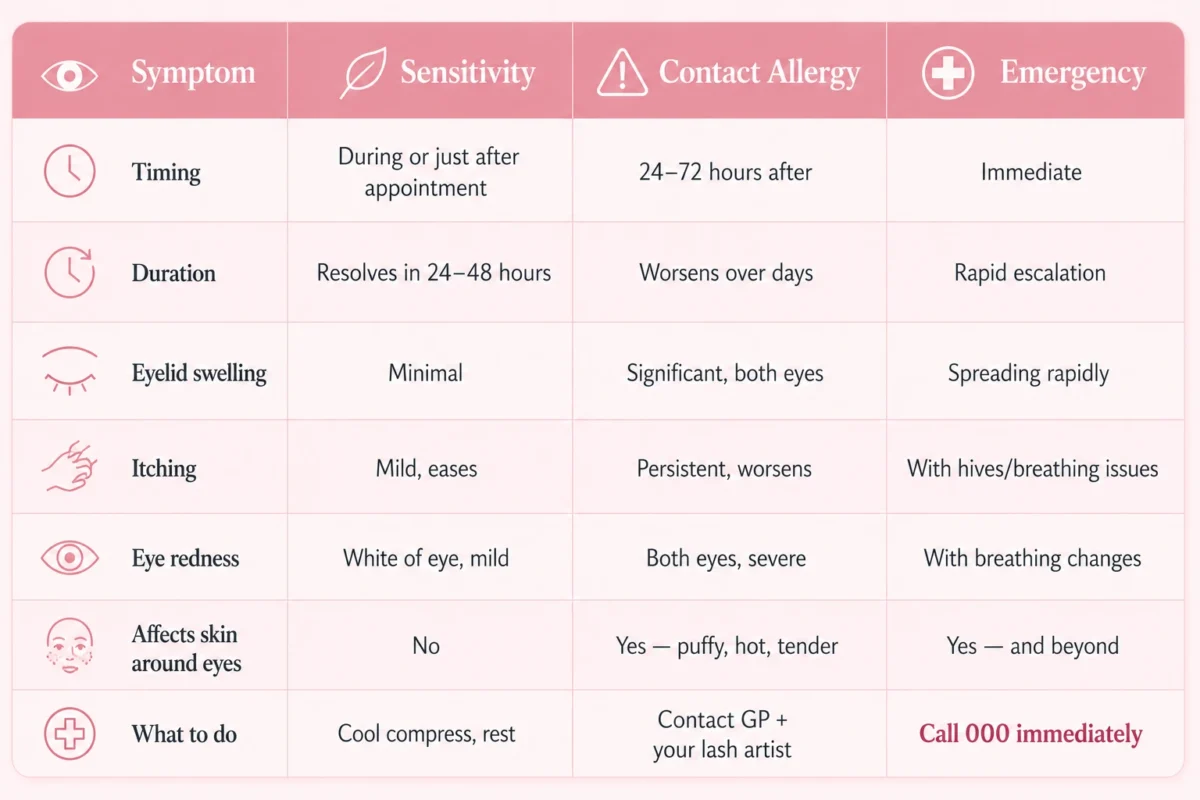
This kind of mild reaction resolves on its own within 24 to 48 hours, doesn’t require treatment, and doesn’t mean you can’t have lash extensions again. It’s usually caused by the fumes from the adhesive, dry eyes from sustained eye-closure during the appointment, or your eyes adjusting to the new weight.
For more on the typical “red eyes” experience, see our Red Eyes After Lash Extensions guide.
2. A contact allergy
A true contact allergy is an immune system response to a specific ingredient — usually cyanoacrylate (the main bonding agent in lash adhesives) or one of several preservatives or carbon black colourings.
A contact allergy feels distinctly different from sensitivity:
- Significant redness and swelling in both eyelids
- Itching that doesn’t ease (rather than transient watering)
- Skin around the eyes feels hot, puffy, and tender
- Symptoms appear within 24 to 72 hours and worsen, rather than easing
- Often affects both eyes equally (because the same product was used on both)
Contact allergies require treatment and unfortunately often mean lash extensions aren’t safe for you long-term — though there are alternatives we’ll cover below.
3. An anaphylactic (immediate, severe) reaction
This is extremely rare with lash extensions but possible. It feels like:
- Rapid swelling of the lips, face, or throat
- Difficulty breathing
- Hives spreading beyond the eye area
- Dizziness or feeling faint
An anaphylactic reaction is a medical emergency. Call 000 immediately.
Anaphylactic reactions are typically only a risk if you have a known severe allergy to lash adhesive ingredients (very rare) or to latex (some older adhesives contained latex). At Posh Deluxe we use latex-free adhesives exclusively — but if you have any known severe allergies, please disclose them at consultation.
Quick-Reference Table: How to Tell the Difference
What Actually Causes Lash Extension Allergies
Understanding the cause helps both prevention and treatment.
Cyanoacrylate (the adhesive itself)
Cyanoacrylate is the polymer that bonds the extension to your natural lash. It’s chemically related to “super glue” — the medical-grade version is specifically formulated for cosmetic application and is non-toxic when used correctly. But cyanoacrylate is the most common allergen in lash extensions.
The good news: even sensitive clients can often tolerate “sensitive” adhesives, which use a slightly different chemical formulation with a lower cyanoacrylate concentration.
Carbon black (the colouring agent)
The black pigment that makes lash extensions actually black. Some clients are sensitive specifically to carbon black rather than to the adhesive itself. Switching to a “clear” or “blue” adhesive (which uses different colouring) can resolve this in many cases.
Latex (in older adhesives)
Older lash adhesives sometimes contained latex. Modern professional formulas — including everything we use at Posh Deluxe — are latex-free. If you have a known latex allergy, always confirm with your lash artist that they use latex-free adhesives only.
Preservatives
Some adhesives contain preservatives like BHA or hydroquinone in trace amounts. Sensitivity to these is rare but possible.
Under-eye patches
The gel patches placed under your eyes during the appointment contain ingredients of their own — usually hyaluronic acid, vitamin E, and various plant extracts. Some clients react to these specifically, not to the lash adhesive at all.
Cleansers, primers, or removers
Pre-treatment products applied to your lashes (primer, dehydrators, lash bath) can occasionally cause sensitivity in clients with reactive skin.
Who Is Most at Risk of an Allergic Reaction?
Some groups are more prone to lash extension allergies than others.
Higher risk:
- Clients with multiple existing allergies (hay fever, eczema, asthma, food allergies) — your immune system is generally more reactive
- Clients with contact dermatitis or atopic dermatitis — your skin is already prone to reacting to contact substances
- Clients with known sensitivity to nail glue or other cyanoacrylate products — same chemical family
- Clients with very sensitive eyes — chronic dry eye, blepharitis, ocular rosacea
- Pregnant clients (in some cases) — heightened immune sensitivity
- Clients who’ve had previous mild reactions to lash adhesive — sensitisation tends to escalate
Lower risk:
- Clients with no history of contact allergies
- Clients with healthy, normal eyes
- Clients who’ve worn lash extensions before without issues (though sensitisation can develop over years)
Patch Testing: The Best Prevention
If you’re new to lash extensions, or if you’ve ever had a reaction to lash products in the past, a patch test is the simplest and best prevention strategy.
What a patch test involves
We apply 4 to 6 extensions on one eye only and ask you to wait 24 to 48 hours before booking your full appointment. If your eye reacts during that window, we know — and we either:
- Try a different adhesive at a second patch test
- Recommend a lash lift instead (no adhesive needed)
- Honestly tell you that lash extensions aren’t right for you
Who should always patch test
- First-time lash extension clients with a history of contact allergies or sensitive eyes
- Anyone returning after a previous reaction
- Anyone who hasn’t worn extensions in 6+ months and has sensitive skin/eyes
- Anyone going through pregnancy, menopause, or significant hormonal changes
- Anyone who’s had a recent skin reaction to any cosmetic product
At Posh Deluxe, we always offer a free patch test for any client who wants one — no pressure, no charge. We’d much rather take 5 minutes to test than have a client react during a full appointment.
Other Prevention Strategies
Choose a professional, licensed lash artist
The single biggest prevention strategy. A trained lash artist:
- Knows how to apply extensions without contact between adhesive and your skin
- Uses professional-grade adhesives, not consumer products
- Maintains a clean treatment environment
- Knows the warning signs and stops if anything looks off
- Has access to a range of adhesive formulations (sensitive, standard, fast-curing) to suit different clients
Avoid “deal” salons with very low pricing, mobile lash technicians without proper training, and anyone who can’t tell you what adhesive they use. The price difference between a budget artist and a properly trained one is usually small — the risk difference is significant.
Don’t get extensions during a flare-up
If you have active eye irritation, hay fever season, recent eye infection, dry eye, or are using prescription eye drops — postpone your appointment. Apply lash extensions to calm eyes only.
Avoid lash growth serums in the lead-up
Many lash growth serums contain prostaglandin analogues that can make your eyes more sensitive. Stop using them at least 1 week before any lash extension appointment.
Disclose your full medical history
When you book, tell us about:
- Any contact allergies (jewellery, cosmetics, household products)
- Any current eye conditions
- Any recent eye surgery, including LASIK
- Any prescription eye drops or treatments
- Any autoimmune conditions
- Any pregnancy or recent pregnancy
For more on what to disclose at any lash appointment, see How to Prep for Your First Lash Appointment.
Choose the right adhesive for your sensitivity
Modern professional lash adhesives come in many formulations:
- Standard adhesives — fast curing, strong bond
- Sensitive adhesives — lower cyanoacrylate concentration, slower curing, gentler on reactive eyes
- Ultra-sensitive adhesives — slowest curing, lowest allergen profile, used for clients with confirmed mild reactions
At Posh Deluxe, we routinely use sensitive-formula adhesives for clients with any history of mild reactions — and we’ll always tell you which we’re using.
What to Do If You Have a Reaction
If you notice any signs of a reaction during or after your appointment, here’s exactly what to do at each level.
For mild sensitivity (most common):
Symptoms: mild redness, watering, eye fatigue, lasting 24 to 48 hours, no eyelid swelling, no persistent itching.
- Cool compresses — wrap ice cubes in a clean tea towel or use a chilled gel mask, apply for 10 minutes
- Lubricating eye drops — preservative-free artificial tears help wash out any residual adhesive fumes
- Rest your eyes — avoid screen time, makeup, and rubbing
- Stay hydrated
- Skip mascara for 24 to 48 hours
- Avoid alcohol — it dehydrates and slows recovery
Most mild sensitivity resolves within 24 hours. If you’re still uncomfortable after 48 hours, contact your lash artist.
For suspected contact allergy:
Symptoms: significant eyelid swelling in both eyes, persistent itching, hot tender skin, symptoms worsening over 24 to 72 hours.
- Contact your lash artist immediately. At Posh Deluxe, we want to know within hours, not days.
- Do not try to remove the extensions yourself. Improper removal can make the reaction worse and damage your natural lashes.
- Contact your GP. They may prescribe an oral antihistamine, a topical steroid ointment, or both.
- Consider professional removal. Your lash artist can professionally remove the extensions in a way that minimises further irritation.
- Cool compresses + lubricating drops can help comfort symptoms while you wait for medical guidance.
For a severe or anaphylactic reaction:
Symptoms: rapid spreading swelling beyond the eye area, hives, difficulty breathing, dizziness, throat tightness, vision changes.
This is a medical emergency. Call 000 immediately. Don’t drive yourself — call an ambulance.
Can I Still Wear Lash Extensions After a Reaction?
This depends entirely on which type of reaction you had.
After mild sensitivity:
Yes — almost always, with adjustments. We’ll switch to a sensitive-formula adhesive, do a thorough patch test next time, possibly use different under-eye patches, and ensure the environment is well-ventilated. Most clients who experienced mild sensitivity return safely.
After a confirmed contact allergy:
Usually no — at least not with traditional cyanoacrylate adhesives. However, alternatives exist:
- A different adhesive chemistry — some clients react to one formulation but tolerate another. A thorough patch test can identify which (if any) adhesive is safe for you.
- A lash lift — uses no adhesive at all, just curls your natural lashes. Beautiful, low-maintenance, often the perfect alternative for clients with adhesive allergies. See our Keratin Lash Lift service page for more.
- A lash tint alone — darkens your natural lashes without any extensions or adhesive.
- A lash serum (non-prostaglandin formulations) for clients who want longer natural lashes.
At Posh Deluxe, we’ll always work with you to find what’s possible — even if traditional lash extensions aren’t.
After a severe reaction:
No to lash extensions, and no to any cosmetic application of cyanoacrylate adhesive (which includes some nail products). Stick to lash lifts, tints, and serums for your lash care going forward, and inform any future beauty practitioners about the reaction history.
A Word on “Lash Glue Allergies” Versus “Lash Adhesive Allergies”
There’s an important distinction often missed in online searches.
Lash glue typically refers to the consumer-grade adhesive you’d use to apply strip lashes at home. These are very different products from professional lash extension adhesives — different formulations, often with stronger fumes, often more allergenic.
If you’ve had a reaction to strip lash glue, you may or may not react to professional lash extension adhesive. They’re related but distinct products. A patch test with a professional adhesive can clarify whether extensions are still safe for you.
Conversely, never assume professional adhesive will react the same as strip lash glue. The chemistries differ.
Frequently Asked Questions
True allergic reactions affect well below 1% of lash extension clients in a properly performed salon environment. Mild sensitivity (which is not a true allergy) is more common — maybe 3 to 5% of clients experience some mild watering or short-term redness — but this resolves without treatment within 24 to 48 hours and doesn’t prevent future lash extensions.
Yes, unfortunately. Allergies can develop after repeated exposure to a substance, even if you’ve tolerated it for years. This is called sensitisation. If you’ve worn lash extensions safely for years and suddenly start having reactions, the most likely explanation is that you’ve developed a new sensitivity to the adhesive. We can patch test alternative adhesive chemistries to see if any are still safe for you.
The most reliable way is a patch test — we apply 4 to 6 extensions on one eye and wait 24 to 48 hours to see if your eye reacts. If you have a history of multiple allergies, sensitive eyes, or have reacted to other cosmetic products, we strongly recommend a patch test before booking a full set. We offer free patch tests at Posh Deluxe.
No lash adhesive is truly hypoallergenic, but some are designed for sensitive clients. These “sensitive” or “ultra-sensitive” formulas have lower cyanoacrylate concentrations, slower curing times, and fewer additives. They reduce — but don’t eliminate — the risk of allergic reaction. A patch test is still recommended for any client with known sensitivities.
Almost certainly not. Mild watering during a lash appointment is extremely common and is caused by the temporary fumes from the curing adhesive. It feels stronger because your eyes are closed for an extended period. The watering should resolve within an hour of leaving the salon. If it persists or worsens, contact your lash artist.
This is sometimes recommended for clients with mild sensitivity, particularly those with hay fever or known mild reactions. Take a non-drowsy antihistamine (like Claratyne or Zyrtec) 1 to 2 hours before your appointment if your GP approves. This can blunt mild reactions but won’t prevent a true contact allergy — for that, the underlying issue is the adhesive itself, not your reactive immune response. If you have a confirmed contact allergy, we’d still recommend not getting extensions even with antihistamines.
Usually yes, because we use the same adhesive on both. If only one eye is reacting, it’s more likely to be a localised irritation (maybe an extension touching the skin, or sweat in one eye) rather than a true allergy. Contact us — we can usually diagnose the cause and address it.
Allergies are immune reactions to the products used; infections are bacterial or other microbial growth. Allergies typically appear within 24 to 72 hours and affect both eyes symmetrically. Infections often appear later (3 to 14 days), affect one eye more than the other, and include yellow or green discharge. Both need medical attention but the treatments are different. If you’re unsure, see your GP.
Yes — this happens occasionally. The gel patches contain ingredients of their own (hyaluronic acid, plant extracts, hydrogel polymers) that some clients react to. If your reaction is localised to the under-eye area rather than the eye itself, the patches are a possible cause. We can use a different patch type next time or apply paper tape instead.
Tell us immediately. If you feel burning, sharp pain, or sudden swelling during the application, we’ll stop, remove what we’ve applied, flush your eyes with sterile saline, and assess. Most “during-appointment” issues are resolvable on the spot — but only if you tell us. Never tough out discomfort.
Honestly, you can’t — biology doesn’t guarantee anything. But you can dramatically reduce your risk by choosing a trained lash artist, doing a patch test, disclosing your full medical history, choosing a sensitive adhesive if appropriate, and avoiding lash extensions during periods of compromised eye health. The combined risk reduction puts you well into “as safe as any cosmetic treatment” territory.
Our Safety Commitment at Posh Deluxe
Lash extensions should feel like an indulgence, not a gamble. At Posh Deluxe Salon in Mount Pleasant, we take client safety extremely seriously — it’s why our reaction rate sits well below the industry average and why our clients trust us with their eyes year after year.
Every lash appointment at Posh Deluxe includes:
- A medical and sensitivity disclosure form at booking
- An honest consultation conversation about your skin and eye history
- A free patch test on request — no pressure, no charge
- Latex-free, professional-grade adhesives with multiple sensitivity tiers available
- A clean, well-ventilated treatment environment
- Trained artists who watch for warning signs throughout your appointment
- Comprehensive aftercare instructions
- Direct contact access to your artist for 7 days after every appointment
If you’ve ever had a reaction to lash extensions elsewhere, or you’re nervous about trying them for the first time — please come in for a free consultation. We’d love to talk through your concerns honestly, recommend the right approach for your specific situation (which sometimes means a lash lift instead, and that’s perfectly okay), and ensure that whatever we do for you is safe, comfortable, and beautiful.
Book your free lash consultation at Posh Deluxe Salon today, or get in touch if you’d like to chat first. Your safety and comfort are always our first priority.
Thank you for taking the time to read this post. Stay tuned for more updates!
Reminder: This guide is informational and reflects current professional consensus in the Australian beauty industry. It is not medical advice. If you experience any sudden, severe, or worsening eye reaction, please seek medical attention immediately. For non-urgent eye concerns, contact your GP or optometrist.