

How to Choose the Right Pigment Colour for Your Cosmetic Tattoo: A Perth PMU Artist’s Guide to Ombre Brows, Lip Blush, and Eyeliner Tattoo
You’ve decided you’re getting cosmetic tattoo. Maybe ombre brows, lip blush, or eyeliner tattoo. You’ve watched the YouTube videos. You’ve saved the Pinterest board. You know the appointment timing, you’ve read the healing guide, and you’ve booked your consultation.
And then your PMU artist asks the one question you weren’t quite ready for: “What colour are you thinking?”
Suddenly the dozens of inspiration photos on your phone look completely different. Some are warm, some are cool. Some are bold, some are barely there. And you realise — pigment colour is the single biggest decision in cosmetic tattoo, and you don’t actually know how to make it.
You’re not alone. Pigment colour is the question we spend the most consultation time on at Posh Deluxe Salon in Mount Pleasant. It’s also the decision that, when made well, gives you a result you genuinely love for years — and, when made poorly, leaves you with a colour that’s all wrong every time you look in the mirror.
This is your complete guide to choosing PMU pigment colour. We’ll walk through how skin undertone affects healed colour, the warm-versus-cool conversation that matters most, how light versus dark colour choices play out long-term, and exactly how to choose pigment for ombre brows, lip blush, and eyeliner tattoo specifically.
First, the Most Important Truth About PMU Pigment
Before we get into the details, here’s the foundation everything else rests on:
The pigment you see in the bottle is not the pigment you’ll see healed in your skin.
PMU pigment changes as it heals. It softens, fades partially, and develops its true tone over 4 to 6 weeks. The colour that looks beautifully bold on day 1 will look completely different at week 5 — and that final colour is what you’ll live with.
An experienced PMU artist works backwards from your final healed colour goal, choosing a pigment that — when implanted, healed, and settled in your specific skin — will produce that final result.
This is why expert pigment matching matters so much. The same bottle of pigment applied to two different clients can heal to two completely different colours. Skin tone, undertone, age, hormones, sun exposure, and even climate all affect how pigment settles.
When you sit down for your PMU consultation, you’re not picking pigment from a colour wheel like nail polish. You’re collaborating with your artist to predict how a specific pigment will look in your specific skin, 6 weeks from now. That’s why training, experience, and honest conversation matter so much.
The Foundation: Understanding Your Skin Undertone
Before we discuss specific colours, you need to understand your own skin undertone — because it shapes every PMU decision.
What is skin undertone?
Your skin has two layers of colour:
- Surface tone: the colour you see in the mirror (fair, light, medium, olive, tan, deep)
- Undertone: the colour beneath, which never changes regardless of tan or season
Undertone determines how pigments interact with your skin — particularly how they heal in cosmetic tattooing.
The three undertone types
Cool undertones:
- Skin reads pink, red, or slightly bluish
- Veins on inner wrist look blue or purple
- Silver jewellery flatters more than gold
- You burn more easily than tan
Warm undertones:
- Skin reads yellow, gold, or peachy
- Veins on inner wrist look green
- Gold jewellery flatters more than silver
- You tan easily and rarely burn
Neutral undertones:
- Skin reads somewhere in between
- Veins on inner wrist look mixed (blue-green)
- Both silver and gold jewellery look fine
- You tan moderately
Why undertone matters for PMU
Pigments and skin undertones interact in predictable but specific ways:
- Warm undertones + warm pigments = beautifully balanced, harmonious result
- Warm undertones + cool pigments = can heal grey, ashy, or muddy
- Cool undertones + cool pigments = clean, balanced, true-to-target result
- Cool undertones + warm pigments = can heal too red, orange, or pink
A great PMU artist always chooses pigment based on your undertone, not just your hair colour or eye colour.
Not sure what your undertone is?
Don’t worry. We’ll assess it at your consultation. We use a combination of:
- Natural light skin assessment
- Wrist vein check
- Jewellery test
- Your historical preferences (you’ll know which lipstick shades flatter you most)
- Eye colour and hair colour balance
Most clients are mildly surprised by their actual undertone — it’s not always what we assume.
Choosing Pigment for Ombre Brows
Brow pigment selection is the most discussed PMU colour decision — partly because brows are so visible, and partly because brow pigment fading patterns are complex.
The two big questions
When choosing pigment for ombre brows, we ask:
- What’s your natural brow colour? Or, if you’ve removed too much over the years, what would your natural brow colour be if untouched?
- What undertone does your skin lean towards?
The general rule of thumb
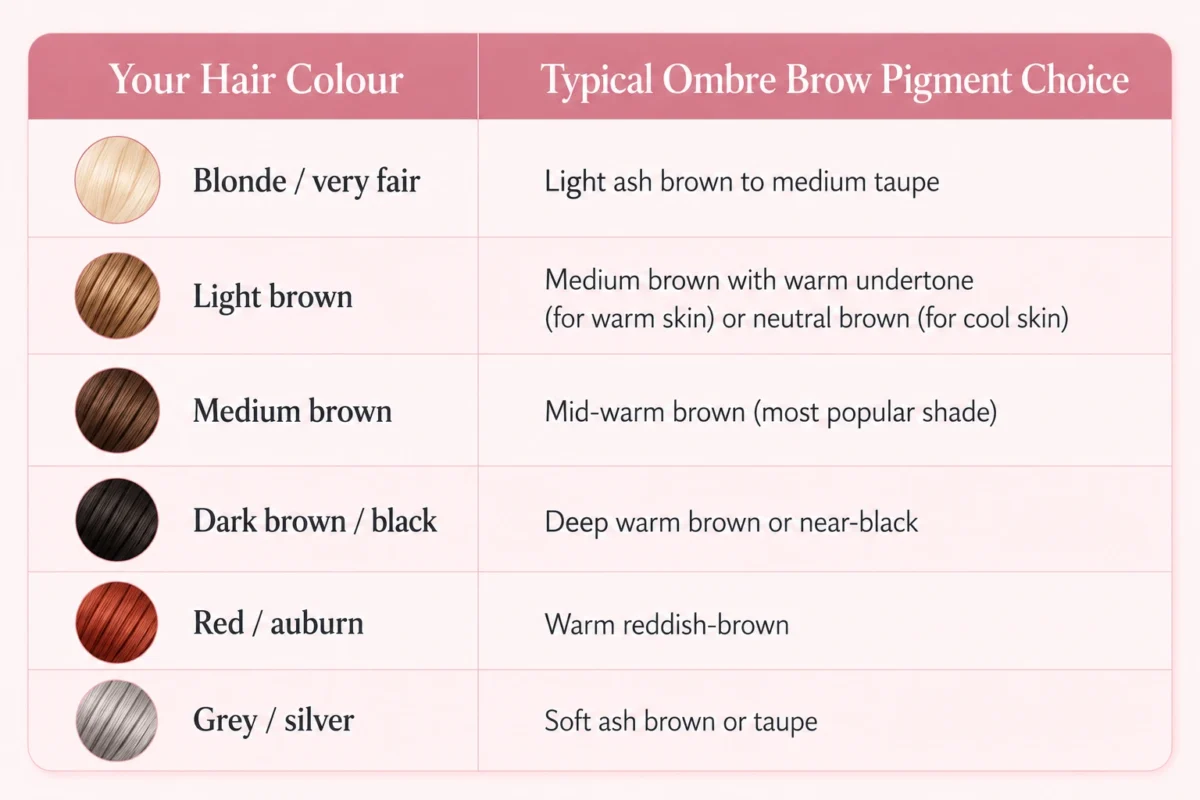
Match the pigment depth to your natural brow colour (or one shade lighter), and the undertone to your skin undertone.
What to avoid
- Going too dark. Most clients walk in wanting brows that look like a brow filler product they love — but PMU at that depth looks far darker once healed and settled. We typically go one shade lighter than expected for a beautifully natural result.
- Pure black or grey pigment. These can heal blue or grey-ash over time, especially on warm skin. Brown-based pigments (even very deep ones) heal more reliably.
- Trying to match your hair if you dye it. Your hair colour may change every 3-6 months; your PMU is permanent. Choose based on your natural hair colour, not your current dye.
For grey or transitioning hair
This is a question we get often from mature clients. The answer:
- If you’re embracing your grey, choose a soft ash brown — it complements grey beautifully and doesn’t look harsh
- If you’re still colouring your hair, choose based on your “natural” base before grey took over
- Avoid going too dark — it can look stark against silver hair
How ombre brows fade
Most brow pigments fade slightly cooler over time (warm tones soften first). This is why a good PMU artist will choose pigment slightly warmer than your target — knowing it’ll heal warm at first, then cool naturally over years to land at the true target colour.
For more on the ombre brows journey, see our Complete Guide to Ombre Brow Tattoo.
Choosing Pigment for Lip Blush
Lip blush pigment selection is often the trickiest because lips have their own existing pigment that interacts with the new colour.
The two big questions
- What’s your natural lip colour? (Look at your lips first thing in the morning, before any food/drink — that’s your true baseline)
- What lipstick shades have you historically loved on yourself?
The general rule of thumb
The pigment doesn’t replace your natural lip colour — it enhances and evens it. A great lip blush still looks like your own lips, just better.
We typically choose pigment colours that are:
- 2 to 3 shades deeper than your natural lip colour
- Aligned with your favourite lipstick warmth (warm coral, cool berry, neutral pink, etc.)
Common lip blush palette directions
- Soft natural pink: lightly enhances natural lip colour, looks like “your lips but better”
- Warm coral: sun-kissed, peachy, romantic — flatters warm undertones
- Rosy pink: classic, balanced, suits most undertones
- Deep berry / wine: dramatic, autumnal, suits cool undertones
- Mauve / nude-mauve: sophisticated, neutral, currently very on-trend
What to avoid
- Going dramatically darker than your natural lips. PMU lips lighten significantly during healing (especially from the bold day-1 colour). But chasing a “vampy” look with deep pigment can leave lips that look too made-up for daily wear.
- Pure red on darker natural lips. Red pigment on naturally pigmented lips can heal patchy or uneven. We’d usually recommend rosy-pink or warm-coral for richer natural lip tones.
- Bright colours that don’t suit your wardrobe. Lip blush is daily wear for 12-24 months. Choose a colour you’d happily wear with everything.
For darker natural lips
If your natural lips have significant pigmentation or unevenness, lip blush is excellent at evening out and brightening — but we use a slightly warmer pigment to neutralise the dark base. The result is still beautifully natural; it just takes a slightly different pigment approach than pale-lipped clients.
How lip blush fades
Lip blush fades fairly evenly over time but tends to soften from the outer border first. Pigment chosen for lip blush is typically warmer than the final target to compensate for natural cooling during healing.
For the complete lip blush journey, see our Day-by-Day Lip Blush Healing Guide.
Choosing Pigment for Eyeliner Tattoo
Eyeliner tattoo pigment selection is generally the simplest of the three — black is by far the most popular choice — but there are still important decisions.
The main pigment options
Black:
- The most popular choice
- Looks like a beautifully drawn liner pencil
- Suits virtually every skin tone, eye colour, and lifestyle
- Fades to deep grey-brown over many years (gracefully)
Dark brown:
- Softer than black, especially flattering for fair clients with warm undertones
- Reads as defined but more “natural”
- Common choice for clients who want subtle definition rather than bold liner
Black-brown:
- A blend of black and brown
- Suits clients who want bold definition without the starkness of pure black
- Particularly flattering for medium skin tones
What we never use
- Pure blue, green, or coloured eyeliner pigment — these don’t heal predictably and can shift colour dramatically over time
- Bright pigments — eyeliner is too close to the eye for adventurous colour choices
The bigger eyeliner decision
The pigment choice usually matters less than the style choice for eyeliner tattoo:
- Lash line enhancement: Pigment placed only within the lash line itself — invisible when eyes open, gives the illusion of fuller lashes. Subtle and universally flattering.
- Classic liner: A defined line above the lash line, similar to drawn pencil eyeliner. Most popular.
- Winged liner: A classic line with an outward flick at the outer corner. More dramatic; requires more skill to execute.
- Smoky liner: Soft shading above and below the lash line. Sultry, sophisticated, more bridal-makeup vibe.
For comprehensive eyeliner tattoo care, see The Complete Eyeliner Tattoo Care Instructions.
The Consultation Conversation: What to Bring
You don’t need to arrive at your PMU consultation with a finished colour plan. We’ll guide you through it. But these things help us nail the right pigment:
Inspiration photos
5 to 10 photos of brows, lips, or eyeliner you love — preferably on women whose colouring (skin tone, hair colour, eye colour) is similar to yours. Photos of yourself with brow makeup, lipstick, or eyeliner you love are also incredibly useful.
Honest colour preferences
What lipstick shades have you historically loved? What brow products do you currently use? Do you tend towards warm or cool palettes in your makeup choices? Tell us — even the “I always wear MAC Velvet Teddy” details matter.
Lifestyle context
Do you spend lots of time in the sun? Live in a tropical climate? Use strong skincare actives? All affect how pigment will fade and how we’d recommend choosing a starting shade.
Hair colour plans
If you dye your hair, are you committed to that colour long-term? Planning to grow out grey? Going lighter for summer and darker for winter? These all factor into the pigment choice.
Be open to recommendations
Sometimes a client walks in absolutely set on a specific shade — and a great PMU artist will honestly say “I think a different choice would suit you better.” Be open to this conversation. We do this every day, and we’ll give you our most honest opinion. You can always say no — but please hear us out first.
For the complete pre-appointment guide, see How to Prepare for Your Cosmetic Tattoo Appointment.
What Happens If the Pigment Heals Wrong?
It’s rare, but sometimes pigment doesn’t heal as predicted. If your final healed colour isn’t quite right, your perfecting session at 6-8 weeks is where we address it. We can:
- Add cool tones to neutralise warm-healed pigment
- Add warm tones to balance cool-healed pigment
- Layer additional pigment to deepen or brighten
- Refine the shape or border to balance the appearance
The perfecting session is included in your treatment at Posh Deluxe specifically because pigment healing isn’t always perfectly predictable. We expect to refine and adjust — that’s how PMU is designed to work.
If, after both your initial appointment and perfecting session, you genuinely don’t love the colour, we can:
- Do an additional adjustment session (cost varies)
- Wait for the natural fade and rework the pigment at your colour boost
- Refer you to professional PMU laser removal if you want a complete reset
For the touch-up journey overall, see our guide to Cosmetic Tattoo Touch-Ups.
Frequently Asked Questions
Yes — significantly. PMU pigment fades by 30-50% during the initial healing phase and continues to soften over the following 4-6 weeks. The colour you see on day 1 is roughly twice as bold as your final healed colour. Trust the process — and trust your artist’s training to predict the final result.
You can refine, deepen, or shift it slightly at your colour boost appointments (every 12-24 months). Significantly changing the colour — say, from a warm brown to a cool grey — usually requires laser PMU removal first and then fresh treatment. This is why getting the initial choice right matters so much.
Skin chemistry, undertone, age, hormones, climate, and skincare routine all affect how pigment heals. Two clients with the same pigment can have wildly different final results. This is why a great PMU artist doesn’t just pick from a chart — they assess your specific skin and predict the outcome based on experience.
You’re welcome to bring colour references, but please understand that an exact match isn’t possible — and isn’t actually what you want. PMU pigment behaves differently from paint, makeup, or hair dye. We’ll use your references as guides for direction (warm vs cool, deep vs soft) but choose pigment based on what we know will heal beautifully on your specific skin.
We can absolutely do bolder PMU — but we’d usually recommend going slightly less bold than your initial impulse. PMU is permanent (or long-lasting) and on your face every day. The “wow factor” of a very bold day-1 result usually settles into something subtler by week 5 anyway — but the bold pigment can over-darken over time too. Bold but flattering is our usual recommendation.
Yes, slightly. If you significantly lighten your hair, your PMU may suddenly look slightly more prominent. If you darken your hair, it’ll look softer. We always factor in your hair colour stability when choosing initial pigment.
Pigment selection for olive, Mediterranean, South Asian, East Asian, Middle Eastern, and African skin tones requires specific expertise. The undertones differ from typical Anglo-Australian skin, and certain pigments heal beautifully on these skin tones while others don’t. At Posh Deluxe, our PMU artists are experienced across diverse skin tones — please mention any specific concerns at consultation.
For natural red or auburn brow colour, we typically use a warm reddish-brown pigment that complements (rather than mismatches) your natural brow hair. Pure brown or black pigment can clash with red hair and look unnatural.
Absolutely. We always do a test dot or test patch with the chosen pigment in an inconspicuous area before we commit to full treatment. You’ll see exactly what we’re using, and we’ll discuss it together before any meaningful work begins.
Save inspiration photos (lots of them), think honestly about what makeup colours you love, be open about your lifestyle and climate exposure, and trust your artist’s expertise. The best consultations are honest conversations between client and artist — not just menus to pick from.
Trust Your Artist, Trust the Process
PMU pigment colour is one of the most important — and most personal — decisions in cosmetic tattoo. The right pigment will make you happy every time you glance in the mirror for years. The wrong one will quietly bother you every single day.
At Posh Deluxe Salon in Mount Pleasant, our award-winning PMU artists have spent years training in pigment selection across every skin tone, undertone, and aesthetic preference. We use premium European pigments specifically chosen for predictable, beautiful healing. And we’ll always have a deeply honest conversation with you about what will actually suit you — even if it’s not exactly what you walked in expecting.
We’d rather take an extra 30 minutes at your consultation to nail the colour conversation than have you live with a result that’s almost-but-not-quite right. The investment in your PMU is significant — the consultation should match.
If you’ve been thinking about cosmetic tattoo and the pigment decision feels overwhelming, please book a free consultation. We’ll talk through everything — your skin, your inspiration, your goals — and recommend the pigment direction that will give you the result you’ll love for years to come.
You don’t have to figure this out alone. That’s what we’re here for.
Book your free PMU consultation at Posh Deluxe Salon today, or contact us for a chat first. We can’t wait to meet you.
Thank you for taking the time to read this post. Stay tuned for more updates!